








Bantam
May 25, 2010
Mass Market Paperback
ISBN-13: 9780553592443
ISBN-10: 0553592440



Order Ebook:



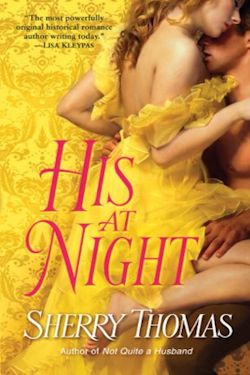
His at Night
Read an Excerpt »
Order the Book »
International Editions »
 HIS AT NIGHT is the 2011 RITA® Award recipient for Best Historical Romance.
Elissande Edgerton is a desperate woman, a virtual prisoner in the home of her tyrannical uncle. Only through marriage can she claim the freedom she craves. But how to catch the perfect man?
Lord Vere is used to baiting irresistible traps. As a secret agent for the government, he's tracked down some of the most devious criminals in London, all the while maintaining his cover as one of Society's most harmless—and idiotic—bachelors. But nothing can prepare him for the scandal of being ensnared by Elissande.
Forced into a marriage of convenience, Elissande and Vere are each about to discover they're not the only one with a hidden agenda. With seduction their only weapon against each other—and a dark secret from the past endangering both their lives—can they learn to trust each other even as they surrender to a passion that won't be denied?
Share:
Watch the Trailer
The Story about the Story
The Journey | Trivia | Bits of Research
The Journey
Sherry owes the conception of this story to Meredith Duran. It was March of 2009, her proposal for the second book in her contract was rejected (yes, published authors get rejected all the time too). Casting around desperately for an idea, she read the excerpt of Written on Your Skin and totally love it. So she begged Meredith for an early look at Written on Your Skin, convinced that if only she could read the whole book, she'd have her idea in hand.
She was right. Written on Your Skin revolved around a man who isn't as nice as he seems and a woman who isn't as dumb as she looks. Sherry flipped around the genders—a man who isn't as dumb as he looks and a woman who isn't as sweet as she appears—and had a successful proposal.
Okay, now she had to write it. The synopsis, which had seemed to hold together pretty well when she submitted it, immediately became problematic. It was about a secret agent and a widow meeting by chance at the house where he had a case. They like each other a lot and begin an affair shortly after their meeting. Well, so what's the conflict? None! No conflict, no story.
Okay, so what they like is not really each other and there will be conflict down the road. But you also can't have a book where the internal conflict only start at the halfway point. So barely three days after receiving approval on the proposal, Sherry already knew she had to make major changes.
Aha, what if the hero is actually investigating a member of the heroine's family and she is trying everything she can to escape said family—and arranged things so that they had to marry? That sounds more promising. People thrust into marriages remain a popular plot for a reason: It generates terrific conflict.
So the widow became an unmarried young lady—Sherry's first virginal heroine—and the focus of the book shifted completely. But Sherry was so accustomed to writing romances with a big backstory, that after a quick prologue, she jumped twenty months into the marriage. She wrote in this mode for about 30,000 words. Then came her editor's edict: No. Why let the conflict dissipate? It would be much better to explore the relationship and the marriage as it is unfolding.
Her editor was right, of course. Sherry went back to the drawing board, and wrote many, many bad drafts—her struggle documented here and here—before she satisfied both her editor and herself.
Sherry has heard of such a thing as a gift book: a book that writes itself. Being an optimist, she is ever hopeful that her next book will be a gift book. But good gracious, this one was another groaner. :-)
Trivia
This book went through a number of working titles. Originally, Sherry was hoping to re-write THE IDEAL GENTLEMAN, her languishing-on-the-hard-drive historical featuring Lord Wrenworth, who has made cameo appearances in a couple of her published books. But the proposal didn't quite work. So when she first started the proposal on Vere and Elissande's story, she referred to it as THE IDEAL IDIOT. Obviously that could not be the real title, so she switched to THE PERFECT DECEPTION, since neither Vere nor Elissande is quite what s/he seems to be. (Sherry's elder son was a fan of this title.) Then Sherry's editor asked for title proposals, something soft-edged yet wicked. Well, that was a tall order. So Sherry moseyed on over to her friend Michelle McGinnis's poetry blog. And boy, a few minutes of great verses inspired a list of nine titles, with YOUR LOVELIEST LIE, lifted directly from an Edna St. Vincent Millay poem, receiving her editor's most enthusiastic endorsement. Sherry was surprised, since the title was very pretty but not exactly come-hither, and she always thought either HIS AT NIGHT or YOURS AT NIGHT, more vague but far sexier, would prevail. And she was right, which goes to show that Sherry really ought to be in advertising!
Image courtesy of Wikimedia Commons
Bits of Research
The Victorians were excellent and thorough chemists. Sherry, to her surprise, rather enjoyed reading through Poisons: Their Effects and Detection. The book is fertile ground for a fiction writer looking for murderous means. :-)

Reviews
"With lush sensuality, intense emotion, lyrical writing, and exquisitely realized characters, Thomas has delivered another unforgettable winner."
— Starred review, Library Journal
"We readers of romance go through a lot of books. A few are wallbangers, more are okay but not great, even more are enjoyable, and some are more than that. When I'm reading a book that falls into that fourth and smallest category, I find myself saying "OMG, I can't believe how good this is" with one part of my brain while the rest of it is saying "shut up and keep reading." His At Night made me feel that way, and I thank you for that. Needless to say, this is an A read for me."
— Dear Author
"Thomas writes with genuine wit and sympathy."
— Publishers Weekly
"Certainly worth the anticipation and buzz it's receiving. The hero and heroine are both interesting, the conflict is compelling and intriguing, and the writing itself is fabulous. It's an all around win."
— All About Romance
"Thomas doesn't just enhance the genre, she enriches it with her intelligent characters, brilliant dialogue, innovative plot twists and amazing love stories. Reading her novels is a rare treat—an insight into the hearts and minds of all who dream."
— 4.5 Star Review and Top Pick, Romantic Times
"This is a Very Good and Compelling Book and I had the hardest time putting it down, even in the midst of a week long party."
— Ramblings on Romance
"Good writing, interesting characters, complex plot...all add up to a firm recommendation from this reviewer."
— Romance Reviews Today
"Tired of spy lords in Regencies? If you said yes, make an exception for His at Night, because it's not tired. It's very much awake and zesty.
Sherry Thomas has taken this subgenre of Regencies and gave it a fabulous new life."
— Love Romance Passion
"[Elissande and Vere are] sad, sweet, frustrating, silly, and utterly absorbing."
— The Good, The Bad, and The Unread
"What worked for me: In short, just about everything. What didn't (work for me): Um, it ended? I had to stop?"
— Kaetrin's Musings
"I loved this thing to pieces. While I was reading it, I never wanted it to end. Love love love."
— The Trillionth Page, by author Carolyn Crane
"Nous ne pouvons que nous incliner devant une telle romance, ambitieuse, grave et superbement écrite."
— Blue Moon
"This book is a roller coaster ride full of emotions that keeps you on your toes."
— Coffee Time Romance
"The real pleasure, of course, is in the getting there, in watching the complex and sexy tango in which Vere and Elissande engage.
There are delicious conversational gambits, and delightfully flirty exhanges, and mouthwateringly-yummy scenes of seduction."
— The Literate Kitty
"This book warrants a second read for certain."
— Kathy L Wheeler, Book End Babes
"His at Night is one of the best reads of the summer. I highly recommend it. Sherry Thomas is building a well-deserved reputation for crafting innovative, engrossing stories with captivating characters, and this is another feather in her cap."
— The Romance Reader
Excerpt
Chapter 1
The Marquess of Vere was a man of few words.
This fact, however, would astonish all but a select few of his numerous friends and acquaintances. The general consensus was that Lord Vere talked. And talked. And talked. There was no subject under the sun, however remote or abstruse, upon which he did not eagerly venture an opinion or ten. Indeed, there were times when one could not stop him from pontificating on that newly discovered class of chemical substance known as the Pre-Raphaelites, or the curious culinary habits of the Pygmy tribes of central Sweden.
Lord Vere was also man who held his secrets close.
But anyone so deluded as to voice such a pronouncement would find himself surrounded by ladies and gentlemen on the floor, screaming in laughter. For Lord Vere, according to public opinion, could not distinguish a secret from a hedgehog. Not only was he garrulous, he volunteered the most intimate, most inappropriate personal knowledge at the drop of a hat—or even without a stitch of haberdashery anywhere in sight.
He gladly related his difficulties with the courting of young ladies: he was rejected early and rejected often, despite his stature as a peer of the realm. He gave up without hesitation the state of his finances—though it had been discovered that he was quite without a notion as to how much funds were at his disposal, current and future. He even ventured—not in mixed company, of course—to comment on the size and girth of his masculine endowment: enviable on both counts, the measurements verified by the experiences of the merry widows who looked to him for an occasional tumble in the sheets.
Lord Vere was, in other words, an idiot. Not a raving one, for his sanity was rarely questioned. And not so moronic that he could not see to his daily needs. Rather, he was an amusing idiot, as ignorant and puffed up as a pillow, silly to the extreme, but sweet, harmless, and very well liked among the Upper Ten Thousand for the diversion he provided—and for his inability to remember anything told him that did not affect his meals, his nightly beauty rest, or the pride and joy that resided in his underlinens.
He could not shoot straight; his bullets never met a grouse except by accident. He rarely failed to turn knobs and levers in the wrong direction. And as his gift for wandering into the wrong place at the wrong time was legendary, hardly anyone batted an eyelash to learn that he was an eyewitness to a crime—without having any idea what he'd seen, most assuredly.
Such an extraordinary idiot had he been in the thirteen years since his unfortunate riding accident that no one not privy to his more clandestine activities had ever remarked on his proximity to some of the most sensational criminal cases of the upper crust, shortly before those cases were solved and the culprits brought to justice.
It was an interesting life, to say the least. Sometimes the tiny handful of other agents of the Crown who knew his true role wondered how he felt about playing the idiot for most of his waking hours. They never found out, for he was a man of few words and held his secrets close.
Of course, no secret remains a secret forever…the beginning of the end of Lord Vere's secret came, quite literally, in an ambush by a young woman of questionable ancestry and equally questionable methods.
A young woman who, in a strange twist of fate, would soon become the Marchioness of Vere, his lady wife.
The rats were Vere's idea. His idea of a joke, to be more precise.
London was emptying at the tail end of the Season. Vere had seen his brother off at the train station earlier in the day; tomorrow he himself was headed for Gloucestershire. There was no time like the beginning of August to appear innocently at a country house to which he might not have been invited—and claim that he had. After all, what was one more guest when there were already thirty of them running about?
But tonight's meeting was about Edmund Douglas, the reclusive diamond mine owner suspected of extorting from the diamond dealers of London and Antwerp.
"We need a better way to get into his house," said Lord Holbrook, Vere's liaison.
Holbrook was a few years older than Vere. When Oscar Wilde had been the country's leading literary celebrity, Holbrook had worn his dark hair long and cultivated an air of intellectual ennui. Now that Wilde had gone off to a disgraced exile, Holbrook's languor was accompanied by shorter hair and a more straightforward display of nihilism.
Vere helped himself to a piece of Savoy cake. The cake was airy and spongy, and just sturdy enough for a spoonful of apricot jam. Holbrook had a way of keeping his hidey-holes—a smattering of properties across metropolitan London—well supplied, so that whenever his agents had to make use of one, there was always good liquor and the makings of a proper tea.
Across the gaudy drawing room—this particular house behind Fitzroy Square had once housed a succession of kept women—Lady Kingsley dabbed a napkin at the corner of her lips. She was a fine-looking brunette about the same age as Holbrook, the daughter of a baronet, and the widow of a knight.
As covert agents, women had the advantage. Vere and Holbrook must assume personas not their own in order not to be taken seriously—an absolute necessity when one went about inquiring after sensitive matters on behalf of the Crown. But a woman, even one as sharp and capable as Lady Kingsley, often managed to be dismissed on nothing more than the fact of her sex.
"I told you already, Holbrook," she said. "We must make use of Douglas's niece."
Holbrook, sprawled on a red velvet chaise trimmed in gold fringe, filliped the most recent case report lying on his chest. "I thought the niece hadn't left the house in years."
"Precisely. Imagine you are a girl of twenty-four years, well past the age when a young lady ought to be married, and isolated from all the gaiety and amusement of proper society. What is the one thing that would tempt you the most?"
"Opium," Holbrook said.
Vere smiled and said nothing.
"No." Lady Kingsley rolled her eyes. "You would wish to meet eligible young men, as many of them as can squeeze under one roof."
"Where do you plan to collect a houseful of desirable bachelors, madam?"
Lady Kingsley waved her hand in dismissal. "That is the easy part, the mustering of manly lures. The problem is that I cannot simply drive up to Highgate Court and present the gentlemen—it's been three months since I leased the next-nearest house and I still haven't met her."
"May I?" Vere pointed at the report on Holbrook's chest. Holbrook tossed the report his way. Vere caught it and skimmed the pages.
Edmund Douglas's estate, in which he'd maintained residence since 1877, was a manor constructed to his specification. There were hundreds of such new country houses all over the land, built by those with a fortune to spare, thanks to the prosperity of the Age of Steam.
A fairly common sort of estate, yet one that had proved difficult to penetrate. Plain burglary had not succeeded. An attempt to infiltrate the staff had also failed. And due to Mrs. Douglas's ill health, the family rarely mingled with local society, rendering useless the more socially acceptable routes into the manse.
"Have a domestic disaster on your part," said Vere to Lady Kingsley. "Then you will have an excuse to approach her."
"I know. But I'm hesitant to damage the roof—or the plumbing—of a leased house."
"Can't your servants come down with something disgusting but not infectious?" Holbrook inquired. "A case of communal runs?"
"Behave yourself, Holbrook. I am no chemist and I will not poison my own staff."
"How about an infestation of rats?" Vere suggested, more to amuse himself than anything else.
Lady Kingsley shuddered. "What do you mean, an infestation of rats?"
Vere shrugged. "Put a dozen or two rats to run about the house. Your guests will scream to evacuate. And the rats won't do permanent damage to the house, provided you have a rat catcher set to work soon enough."
Holbrook sat up straight. "Splendid idea, my dear fellow. I happen to know a man who breeds mice and rats to supply scientific laboratories."
That did not surprise Vere. Holbrook had at his fingertips a large assortment of bizarre and bizarrely useful contacts.
"No. It's a terrible idea," Lady Kingsley protested.
"Au contraire, I think it is pure genius," declared Holbrook. "Douglas travels to London to meet with his solicitor in two weeks, am I correct?"
"Correct," said Vere.
"That should be enough time." Holbrook reclined back onto his red velvet chaise. "Consider it done."
Lady Kingsley grimaced. "I hate rats."
"For Queen and country, madam," said Vere, rising. "For Queen and country."
Holbrook tapped a finger against his lips. "Funny you should mention Queen and country, my lord: I have just received word of the blackmailing of a certain royal and—"
Vere, however, had already shown himself out.
Chapter 2
Two weeks later
Miss Elissande Edgerton stood before the manor at Highgate Court. Rain pummeled her black umbrella; a cold gray mist obscured all but the driveway.
August, and already it felt like November.
She smiled at the man before her. "Have a safe journey, Uncle."
Edmund Douglas returned her smile. It was a game to him, this façade of affection. There is no crying in this house, do you understand, my dear Elissande? Look at your aunt. She is not strong or clever enough to smile. Do you wish to be like her?
Even at six, Elissande had known that she had no wish to be like her aunt, that pale, weeping specter. She hadn't understood why her aunt had wept. But whenever Aunt Rachel's tears had spilled, whenever her uncle had placed his arm about his wife's shoulders to lead her to her room, Elissande had always left the house and run as far away as she dared, her heart pounding with fear, revulsion, and an anger that burned like smothered coal.
So she had learned to smile.
"Thank you, my dear," said Edmund Douglas.
But he made no move to enter the waiting brougham. He liked to prolong his good-byes—she suspected he knew very well how much she ached for him to be gone. She stretched out her smile.
"Take care of your aunt for me while I'm gone," he said, his face lifting toward the window of his wife's bedchamber. "You know how much I treasure her."
"Of course, Uncle."
Still smiling, she leaned in to kiss him on his cheek, controlling her aversion with an expertise that made her throat tighten.
He required this demonstration of familial warmth before the servants. It was not every man who disguised his evil so well that he fooled his own staff. One heard rumors of Squire Lewis's bum pinching, or Mrs. Stevenson's watering of the beer she provided her servants. But the only sentiment circulated about Mr. Douglas was a uniform admiration for his saintly patience, what with Mrs. Douglas being so frail—and not altogether right upstairs.
At last he climbed into his carriage. The coachman, hunkered down in his mackintosh, flicked the reins. The wheels scraped wetly against the gravel drive. Elissande waved until the brougham rounded the curve; then she lowered her arm and dropped her smile.
Vere slept best in a moving train. There had been times in his life when he'd taken the Special Scotch Express from London to Edinburgh for no reason other than the eight hours of dreamless slumber it offered.
The trip to Shropshire was less than half as long and involved several changes of trains. But still he enjoyed it, probably the most he'd enjoyed himself since his naps on the way from London to Gloucestershire, where he'd spent the previous two weeks retrieving a contingency invasion plan that the Foreign Office had somehow "lost." A delicate task, considering that the target of the plan was German South West Africa—and relations with Germany were strained at best.
He'd accomplished his assignment without a whiff of international scandal. His pleasure at his success, however, was muted. He led his double existence for the pursuit of Justice, not to bail out fools who couldn't keep sensitive documents away from harm.
But even when the cases did feed his hunger for Justice, even then his satisfaction was hollow and short-lived—the feeble glow of embers about to turn into ash—followed by an exhaustion that lingered for weeks.
An emptiness that the deepest, most nourishing slumber could not erase.
The carriage Lady Kingsley had sent for him sped through miles of rolling green country. He could no longer sleep and he did not want to think of his next case. Granted, Edmund Douglas's general reclusiveness had necessitated an unusual amount of planning, but the investigation was simply another in a career filled with unorthodox cases that local police could not solve, and often did not even know about.
He stared out of the carriage. Instead of well-grazed grassland, still wet with rain but glistening under a newly emerged afternoon sun, he saw a different landscape altogether: crashing waves, high cliffs, moors purple with heather in bloom. A path at the top of the slopes stretched before him; a hand, warm and steady, held his own.
He knew the path. He knew the cliffs, the moors, and the sea—the coasts of Somerset, North Devon, and Cornwall were exceptionally beautiful places he visited as often as he could. The woman who held his hand, however, existed only in his imagination.
But he knew her light, lithe footfalls. He knew her sturdy wool skirt: it shushed softly when she walked, a sound he could hear only when the air was still and the path high, away from the pounding of the waves. And he knew the contour of her nape, beneath the wide-brimmed hat that protected her skin from the sun: he had draped his coat over her shoulders many times, when her own jacket proved inadequate against the coast's cool and variable weather.
She was an indefatigable hiker, a serene friend, and, at night, a sweetly accepting lover.
Fantasies were like prisoners, less likely to stage a revolt if allowed judicious amounts of supervised exercise. So he thought of her often: when he could not sleep, when he was too tired to think of anything else, when he dreaded going home after weeks upon weeks wishing for quiet and solitude. All she had to do was lay a hand on his arm, her touch warm with understanding and care, and he would be all right, his cynicism soothed, his loneliness subdued, his nightmares forgotten.
Copyright © 2010 by Sherry Thomas. Excerpted by permission of Bantam Books, a division of Random House, Inc. All rights reserved. No part of this excerpt may be reproduced or reprinted without permission in writing from the publisher.
International Editions
 English (not NA)
 France
 Germany
 Germany
Reissue
 Indonesia
 Portugal
 Russia
 Slovenia
 Thailand
 Vietnam